Showing posts with label Hales. Show all posts

Friday, 9 December 2011

*Where* is the information?

At Digital by Default last week one of the 'Masterclasses' that I attended was by epay, who provide electronic payment systems.

They were talking about stored-value cards, such might be used by schools for children to pay for their lunch, or store 'gift cards'.  The way their system works (or the one they were talking about at the event) is that the credit on the card is stored on a central database, and, when the card is used for payment, the payment terminal communicates with the central database to check for available balance and deduct value as appropriate.

A couple of thoughts:

1) One of the virtues of the system - as presented by epay - is that it tracks use of the card. The central database 'knows' where and when the card is used.  You wouldn't necessarily realise that, I'd not thought about it for store gift cards anyway. I'd thought of them as like cash, with the value 'on' the card, and therefore essentially untraceable.  Of course a gift card can be passed between people (given as gift!) and you are not tracking who is using it, so it's not tracking you like a credit or debit card does, but even so it's not as anonymous as cash.  Sometimes I like being anonymous (even though, pace Paul McMullan, I'm not a paedophile*)

2) But more relevant to the exploration of the nature of information, it draws attention to the problem of locating information.  I thought the information was on the card, but it's not, it is on the database. But actually epay have more than one database. The main database is in Germany, then they have a mirror in the UK. So is the information on the German database or the one in the UK?  And presumably they have a backup, so that if the database crashes it can be recovered.

There's nothing special about this, about stored value cards.  Similar things can be said about, for example, the text I'm typing on my PC at the moment. Where is it? Is it on my computer, or on one of Google's computers somewhere?  It's just that the stored-value card brought the question into sharp relief, because you might think the information is on the card (well I thought it was).

But even with cash when you start to think more carefully it's not so clear where the information is. Information is money but a five-pound note (or a pound coin) is only any use by virtue of its relationship to the monetary system in which is resides. This is reminder that information might have a body, but it doesn't reside in the body (think about Katherine Hales).

As an aside, not all card payment systems work in this way. Some use smart cards which store information on them.  Apparently the Oyster cards used on the London underground are smart cards which keep track of the credit on the card. There is a central database, however, and the Oyster card terminals communicate with the central database which is updated overnight. (Thanks to one of the epay people at Digital by Default for explaining this. epay don't run the Oyster card system but he knew how it worked.)

--------------------

* Paul McMullan, former deputy features editor of the News of the World. Actually he was referring to privacy, but it's the same idea.  McMullan's evidence to the Leveson inquiry (from the Guardian live blog, Tuesday 29 November 2011):

 4.20pm: McMullan is asked to clarify whether he believes that no one should have privacy. He says "yes".
In 21 years of invading people's privacy I've never actually come across anyone who's been doing any good. Privacy is the space bad people need to do bad things in.
Privacy is evil; it brings out the worst qualities in people.
Privacy is for paedos; fundamentally nobody else needs it.
http://www.guardian.co.uk/media/blog/2011/nov/29/leveson-inquiry-nick-davies-paul-mcmullan-live

Thursday, 14 April 2011

Illegal music downloads

The Report on Radio 4 this evening "investigates the battle over the government's plans to stop illegal downloading of music" and asks: "Is the digital economy bill unravelling?"

Here's a little extra. The programme describes the accusations that Peter Mandelson was unduly influenced by the music industry. Ray Corrigan writes about this in Chapter 11 of Perspectives on Information, and has an interesting anecdote:
In August 2009, Lord Peter Mandelson, the UK Secretary of State for Business,
Innovation and Skills and President of the Board of Trade, went to
Corfu on holiday, as a guest at the Rothschild family estate. Whilst he
was there, he met philanthropist and entertainment mogul, David Geffen,
founder of companies like Asylum Records and Dreamworks. The business
secretary then returned from holiday, infused with an enthusiasm, which
some argued was not previously in evidence, for clamping down on illicit
file sharing on the Internet
In the end, the conclusion is that whatever you may think of the rights and wrongs, however much you may worry about the consequences, the genie is out of the bottle and the music industry will have to adapt.(That sounds rather technologically determinist, doesn't it?)

Recorded music is information, and information has lost its body.

Friday, 1 April 2011

Restoring Information's Body - talk by Lucy Suchman

Professor Lucy Suchman, Professor of Anthropology of Science and Technology, Department of Sociology, Lancaster University, yesterday spoke at the OU on Restoring Information's Body.

Here's the abstract of her talk:
In her book 'How we became post-human' Katherine Hayles has famously explored the question of how information lost its body in the formative years of the information sciences in the middle of the last century. Professor Suchman's lecture takes off from this question to explore recent developments in the study of digital media that recover the entanglements of bodies and technologies. Drawing on a series of examples from her own research and others within Science and Technology Studies (STS), Professor Suchman will make the case for an understanding of information as irreducably social and material, virtual and real.
A few things I noted from what she said.
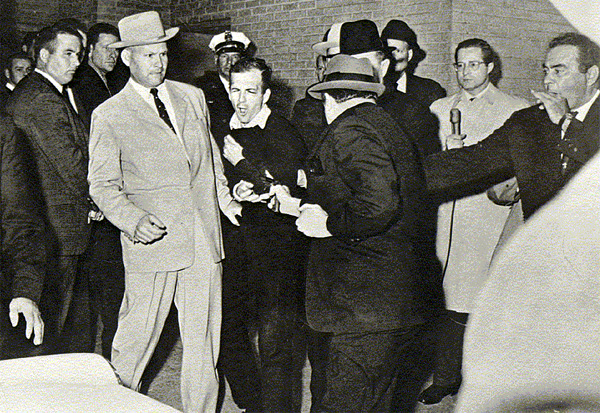
  • The slogan of the National Rifle Association (NRA) in the USA: "Guns don't kill people, people kill people". Illustrated by Suchman with the iconic image of the assassination of Lee Harvey Oswald.
Source: AND magazine

Suchman spoke of Bruno Latour's analysis that you are different when you hold a gun, and the gun is different when it is held by you. This morning I've tracked down a paper in which Latour discusses the NRA slogan("On Technical Mediation" Common Knowledge Vol.3, n°2 p.29-64 which I downloaded from here)

I wouldn't have thought of this in terms of information, and that's not how Latour is presenting it in this paper - it's about agency ("do artefacts - guns - have agency?") But perhaps that wasn't Suchman's point. She extracted from the story Latour's idea of identifying the 'unit of analysis' (the gun plus the person) which is what is needed when considering information too - the information plus the body?
  • The concept of the figural, extracted from the word configuration. This being the way things are configured. Then, from Donna Haraway (Modest_Witness 1997) the idea of technologies as 'materialised figurations'.
  • "Multiple partial information sources, assembled into a working system." "Embodied ways of knowing" (Vivian Sobchack). Suchman talked about observing the activities of air traffic controllers. (I was reminded in this of Paul Lefrere's chapter in our upcoming book Perspectives on Information, and the idea of exformation, the context that is needed to make sense of communicated information.)
  • A paper she has shortly to be published about the 'robot' Mertz.
  • The idea, from Susan Star, of 'Things that are invisible'.
  • "We need to give up on the idea of comprehensive capture." "Work with 'cases' or 'fragments'". (I might say 'map'?)
  • The art installation "Standard Time"

Wednesday, 30 March 2011

The body of Kafka's work

Kafka famously left his work with his friend Max Brod, together with instructions for it to be destroyed after his (Kafka's) death.

Brod didn't destroy it.  He published some (including The Trial, The Castle and Amerika), but kept a lot back, stored in suitcases, which was supposedly a compromise between destroying and publishing. After his death it went to his secretary, Esther Hoffe, and then when she died (aged 101) in 2007 it was inherited by her daughters Eva and Ruth.

Now the remaining material is to be sold, but there is a bizarre twist, as recounted in the London Review of Books:
What no one could have predicted, however, is that a trial would eventually take place after Esther’s death in which her daughters, Eva and Ruth, would claim that no one needs to inventory the materials and that the value of the manuscripts should be determined by their weight – quite literally, by what they weigh. As one of the attorneys representing Hoffe’s estate explained: ‘If we get an agreement, the material will be offered for sale as a single entity, in one package. It will be sold by weight … They’ll say: “There’s a kilogram of papers here, the highest bidder will be able to approach and see what’s there.”

"Who owns Kafka"  Judith Butler LRB 3 March 2011
Butler goes on to discuss the wonderfully convoluted arguments as to where the material ought to go, taking in issues of Kafka's identity and ideas in his writing. (The article is available free on the LRB's website so you can read it all online). However, the specific information angle I wanted to flag here is in a letter about it that appeared in the next issue:
Assuming it were in his or her power, a presiding judge could make it a condition of ownership that the entire archive, every last scrap of it, be digitised and made freely available in suitable downloadable format over the internet. Anyone, anywhere could then construct a personalised version of the archive, organised in any way they saw fit. The physical location of the original material would become a matter of little importance, of interest only to paper fetishists and the odd forensic scientist, for goodness knows what arcane research project. More properly, the papers themselves would be destroyed once digitisation were complete, finally honouring Kafka’s wishes, and leaving the work itself truly weg von hier, for if anywhere meets the conditions of a destination that, as Judith Butler puts it, is not a place as we know a place to be, it is surely cyberspace, or whatever we choose to call it these days.

Martin Jenkins LRB 17th March
I'm sure you can see the information angles, but I'm thinking particularly of Katherine Hales' "Information has lost it's body". Does destroying the body honour Kafka's wishes? (And I wonder whether I'm a "paper fetishist"!)

Update 7 April, the papers have been jointly purchased by Oxford's Bodleian library and the Deutsches Literaturarchiv (German Literary Archive) in Marbach (http://www.guardian.co.uk/books/2011/apr/04/kafka-letters-oxford-german-literary-archive)