Showing posts with label abstraction. Show all posts

Thursday, 12 July 2012

Kybernetes Keywords: maps and miscellaneous

Together with colleagues Magnus Ramage and Chris Bissell, I have been appointed a co-editor of Kybernetes (the first issue under our names will be January 2013).

At the same time as us taking it on the journal is moving over to an online submission system. and one of the first tasks we've had to do is set up the initial list of Keywords. Emerald gave us a list from previous papers, but that list contained 910 words.

Our first reaction when we'd thought about Keywords was that they have little value these days, since you can do a full-text search instead. However, on reflection we realised that there are things we'd use Keywords for, things that a full-text search doesn't replace. For example, we thought about looking for reviewers. When you get a paper and need a reviewer, you need to find someone who knows about the field, which ideally would be identifiable by the Keywords. Of course, 'the field' can means lots of different things, it could be 'cybernetics' in a sense which might cover anything and everything published in Kybernetes, or it could be much more specific. It's about the level of abstraction, and I think the point is that the level of abstraction of Keywords should, in our opinion, be the level that you use in identifying a reviewer. That might sound a bit circular, but I don't think it is, It is about defining the level of abstraction appropriate for Keywords.

910 words is certainly too many. Either the words are too specific, too narrow to help in finding a reviewer, or else they come from too wide a field, taking in topics that are not appropriate for Kybernetes. The 910 word list was a bit of both. It was mainly too specific, but also - in a few cases - covering some topics that we don't think are really appropriate for Kybernetes.  (There were also quite a few cases of alternative spellings or synonyms, which clearly should be removed.)  We thought that we would want about 50-100 Keywords, but when we tried cutting down and editing the list, we came to 127 words (see below).

Apart from the practical issue of choosing reviewers, this list serves - or should serve - to identify the field of interest of Kybernetes. It is a map of Kybernetes.  It will evolve - we can add and remove terms as we go along - but it should help to understand what Kybernetes is for.

One of the most useful things for me about this blog has been the list of labels. At the moment there's about 140 labels (see in the left hand column).  As time has gone along, some of the labels I previously used have seemed less significant and others have become more important. Again, you don't need the labels because Blogger can easily do you a search of the full text, but that's not the point. The labels are the map and the map defines the territory (see what I've said about maps before by clicking on the map label). The labels are defining what this blog is about, and are defining what I think the territory of information is.

The map is not the territory, but without the map the territory is incomprehensible. The territory might as well not exist. Maybe everything is miscellaneous, but you can't comprehend 'everything', you can only comprehend the map.

Appendix: the initial map of Kybernetes

Here's the list of 127 terms we are starting with. I should put in the disclaimer at this stage that we generated it by cutting down the full list of 910, and we did it rather quickly so as not to delay the site going live. As I said above, it will evolve as we add and remove terms. It will become a more useful map, better representing the Kybernetes territory.


Action research, Adaptation, Aesthetics, Algorithms, Analogue, Analogy, Approximation theory, Architecture, Art, Artificial intelligence, Automata theory, Automation, Autopoiesis, Behaviour, Biocybernetics, Biology, Biometrics, Biophysics, Boolean algebra, Brain, Business systems, Causality, Chaos theory, Citizenship, Classification, Cognition, Communication, Communications technologies, Complexity, Consciousness, Control systems, Creativity, Critical thinking, Cross-cultural studies, Curricula, Cybernetics, Decision making, Design, Dynamics, Ecology, Economics, Education, Emergence, Energy technology, Environmental management, Epistemology, Ethics, Evolution, Experimental psychology, Feedback, Fuzzy logic, Gaia hypothesis, Game theory, Genetic algorithm, Globalization, Governance, Heuristics, History, Homeostasis, Human biology, Image processing, Information, Information systems, Information technology, Information theory, Intelligent agents, Internet, Knowledge management, Language, Learning, Linear programming, Management, Management information systems, Markov processes, Mathematical modelling, Measurement, Modelling, Monte Carlo simulation, Music, Nanotechnology, Narratives, Networking, Neural nets, Nonlinear systems, Numerical analysis, Open systems, Operational research, Optimization techniques, Organisational structures, Phenomenology, Philosophy, Physics, Politics, Probability theory, Problem solving, Project management, Protocols, Public policy, Quantum computing, Recursion, Relativism, Risk management, Robotics, Second-order cybernetics, Self-organization, Self-referential systems, Semantics, Sensors, Signal processing, Simulation, Social change, Social networks, Social systems, Sociocybernetics, Sociology, Statistical analysis, Sustainability, System dynamics, Systemic thinking, Systems theory, Tektology, Telecommunications, Topology, Turing test, Viable Systems, Wireless, World Wide Web

Tuesday, 7 February 2012

Abstract & arbitrary symbolism, information and life

Serendipity led me to: Information, Intelligence, and the Origins of Life by Randy Isaac. (Perspectives on Science and Christian Faith, v63 n4 pp219-230)  The paper tackles the theory (put forward by Intelligent Design proponents, especially William Dembski) that consideration of information leads to the need for a creator God. Isaac disagrees with that thesis. (And so do I, for the record!)

Isaac's paper very nicely summarises many key issues in the field, but for this post I want to pick up on one specific issue.  He discusses the distinction between what he calls "physical symbolism" and "abstract symbolism". Abstract symbolism is what I've previously referred to as arbitrary symbolism (well, maybe, see below), and this binary distinction links to the distinction between environmental and semantic information (which I discussed here).

Here's some quotes from Isaac:
In physical symbolism, the symbol has a physical property which serves as the message. For example, a shiny, smooth metal surface can serve as a symbol of high reflectivity. Or a north pole of a magnet serves as a physical symbol of attraction to a south pole magnet. The meaning or significance of a physical symbol is derived from the physical properties of the symbol itself. 
In abstract symbolism, the symbol has a meaning assigned to it which does not necessarily derive from its physical properties.
So far so good. He later says:
Abstract symbolism is a hallmark of intelligence. ... The ability to associate abstract symbolic significance with a distinguishable physical pattern is a key indicator of intelligence, though not the only factor. ... When abstract relationships are a necessary part of information systems, then an intelligent agent must be involved to generate or interpret or design that system.
So, where does that leave the peacock? Is the peacock's tail not an abstract (arbitrary) sign? Or is the peacock intelligent?  Actually, when I wrote that about the peacock I was aware or a possible problem with my claim that "the sign is arbitrary since other birds manage with different signs meaning essentially the same thing": maybe the sign is not arbitrary to the peacock (or peahen). A peacock couldn't one day decide to woo a peahen with, say, a crest, instead of his tail. He wouldn't 'know' to do that and if he did the peahen wouldn't understand.  Still, I think non-human animals can work with abstract symbols, but it needs teasing out a bit more carefully, and I'm still not sure whether that being the case means that animals display intelligence or that arbitrary signs don't need intelligence.

John Maynard Smith in his chapter (The Concept of Information in Biology, page 130) in Davies and Gregersen (Information and the Nature of Reality) says of the genetic code:
The correspondence between a particular triplet and the amino acid it codes for is arbitrary. Although decoding necessarily depends on chemistry, the decoding machinery (tRNAs, assignment enzymes) could be altered so as to alter the assignments. Indeed, mutations occur that are lethal because they alter the assignments. In this sense the code is symbolic.
This is the same sense of arbitrary that I was using about the peacock's tail. (I wonder, maybe there is a difference between Isaac's 'abstract' and Maynard Smith's 'arbitrary'?)

Something to flag for discussion another day. Maynard Smith argues that there is intention in the genetic code. I didn't understand that when I first read his chapter but I think I do now. (His ideas have been digested by my subconscious and were regurgitated when I was reading Isaac's paper!) But that is for a later  post.

Friday, 1 April 2011

Restoring Information's Body - talk by Lucy Suchman

Professor Lucy Suchman, Professor of Anthropology of Science and Technology, Department of Sociology, Lancaster University, yesterday spoke at the OU on Restoring Information's Body.

Here's the abstract of her talk:
In her book 'How we became post-human' Katherine Hayles has famously explored the question of how information lost its body in the formative years of the information sciences in the middle of the last century. Professor Suchman's lecture takes off from this question to explore recent developments in the study of digital media that recover the entanglements of bodies and technologies. Drawing on a series of examples from her own research and others within Science and Technology Studies (STS), Professor Suchman will make the case for an understanding of information as irreducably social and material, virtual and real.
A few things I noted from what she said.
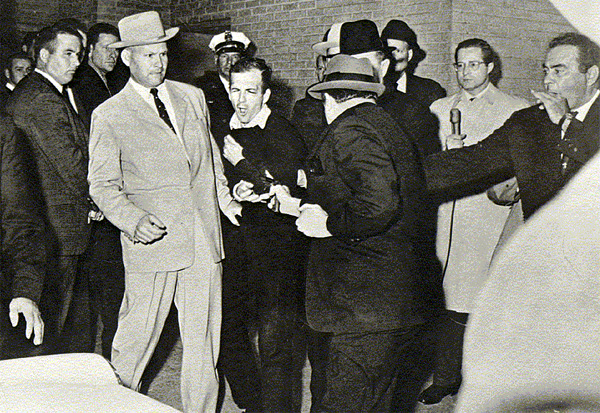
  • The slogan of the National Rifle Association (NRA) in the USA: "Guns don't kill people, people kill people". Illustrated by Suchman with the iconic image of the assassination of Lee Harvey Oswald.
Source: AND magazine

Suchman spoke of Bruno Latour's analysis that you are different when you hold a gun, and the gun is different when it is held by you. This morning I've tracked down a paper in which Latour discusses the NRA slogan("On Technical Mediation" Common Knowledge Vol.3, n°2 p.29-64 which I downloaded from here)

I wouldn't have thought of this in terms of information, and that's not how Latour is presenting it in this paper - it's about agency ("do artefacts - guns - have agency?") But perhaps that wasn't Suchman's point. She extracted from the story Latour's idea of identifying the 'unit of analysis' (the gun plus the person) which is what is needed when considering information too - the information plus the body?
  • The concept of the figural, extracted from the word configuration. This being the way things are configured. Then, from Donna Haraway (Modest_Witness 1997) the idea of technologies as 'materialised figurations'.
  • "Multiple partial information sources, assembled into a working system." "Embodied ways of knowing" (Vivian Sobchack). Suchman talked about observing the activities of air traffic controllers. (I was reminded in this of Paul Lefrere's chapter in our upcoming book Perspectives on Information, and the idea of exformation, the context that is needed to make sense of communicated information.)
  • A paper she has shortly to be published about the 'robot' Mertz.
  • The idea, from Susan Star, of 'Things that are invisible'.
  • "We need to give up on the idea of comprehensive capture." "Work with 'cases' or 'fragments'". (I might say 'map'?)
  • The art installation "Standard Time"

Thursday, 11 November 2010

Musing on ancient worlds and civilisation

Watching Ancient Worlds on BBC2 last night, I was wondering to what extent 'civilisation' is defined by the manipulation of information?

I was marvelling at the firing of bricks 5000 years ago. It is common to talk of the role of technology in civilisation, but is there a storyline that says it is the manipulation of information that 'really' defines civilisation?

The programme emphasised the importance of writing, and the information link is obvious there, but is there any value in arguing that the firing of bricks and building of walls is also dependent on information?

Partly I'm wondering about the distinction - if there is one - between firing bricks to build a house, and, say, a House Martin using mud to build a nest.

Something to do with abstraction, which you can only do with information.